Travel power · Italy
Italy Travel Adapter: What Plug Do You Need?
Short answer: Italy uses type L sockets, and many outlets also accept the thinner type C Europlug. Supply is 230 V at 50 Hz. Whether your own device is fine depends on the INPUT line printed on it, not on the country alone.
Country data verified 9 November 2026 · next review 9 May 2027
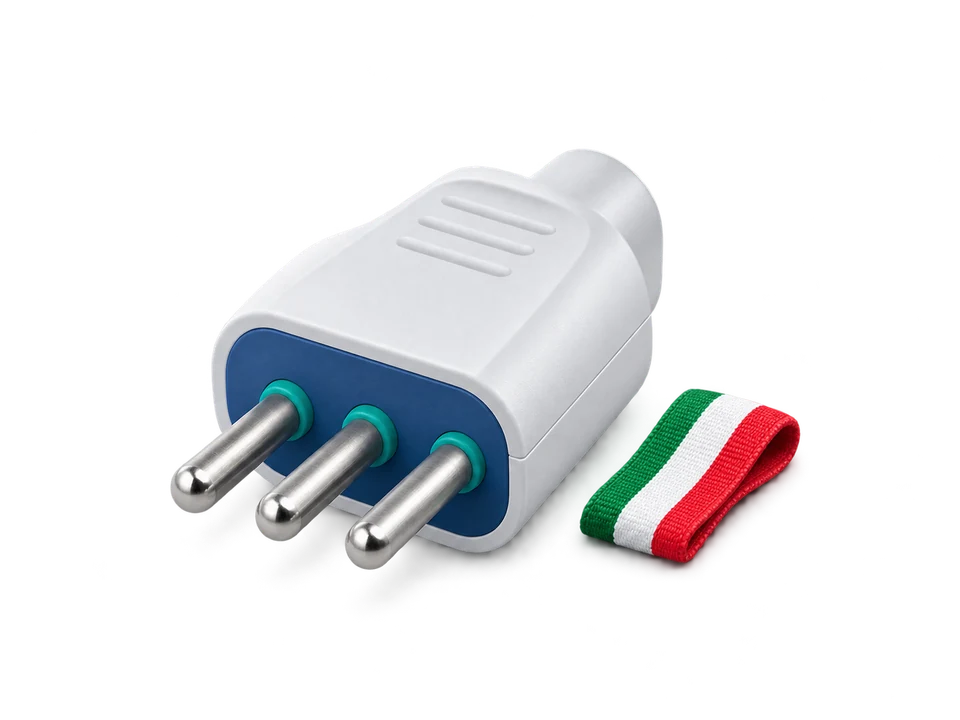
A plug adapter does not convert voltage. If your device is marked 120 V only, a type L adapter will let it plug in and still leave it connected to 230 V. That is the failure mode this page exists to prevent.
Italy at a glance
| Socket types | Type L (three round pins in a row) is standard. Type C Europlugs fit many type L sockets, and type F (Schuko) plugs fit some, but this varies by outlet — you cannot assume a specific wall socket accepts them. |
|---|---|
| Nominal voltage | 230 V (within the 220–240 V European band) |
| Frequency | 50 Hz |
| Type L is not one size | The Italian standard exists as a 10 A version (4 mm pins, 19 mm spacing) and a 16 A version (5 mm pins, 26 mm spacing). They are not interchangeable, so an adapter that fits one socket may not fit the next. A modern "bipasso" outlet accepts both sizes plus the type C Europlug, but not every outlet in an older building is a bipasso. |
| Earthing | Type L sockets exist in earthed and unearthed versions; earthed devices need the earthed variant. Type C has no earth pin at all. Do not assume the outlet in a hotel room is earthed. |
| What you need if you are from North America | A plug adapter for the socket shape, plus confirmation that your device's input range covers 230 V — usually stated as 100–240 V. |
| What you need if you are from the UK or Ireland | A plug adapter from type G to type L or C. Voltage is compatible, so a converter is not required for devices rated 230 V. |
Check the label, not the country
Almost every phone charger, laptop power supply and camera charger sold internationally is marked with a range such as INPUT: 100–240 V~ 50/60 Hz. That string means the device is built to tolerate both the 120 V and the 230 V worlds. If your label shows a range like that, in Italy you need only the plug shape.
If the label shows a single voltage, such as 120 V~ 60 Hz, the device is not intended for 230 V. A plug adapter does not change that. Neither does a cheap "travel converter" claiming universal support — those are frequently rated for heating appliances only, for short duty cycles, and rarely for electronics.
Where the input line is printed
- On the charger brick itself, in small print, often between the pins.
- On the device bottom or rear panel if the power supply is built in.
- In the specification section of the manufacturer's manual, if the printing has worn off.
Phones, laptops and everything with a USB charger
A modern USB power supply with a 100–240 V input works on Italian supply. The things that actually differ are the socket shape and, if you are charging from a wall outlet rather than a power bank, the number of outlets available in the room. A single adapter plus a multi-port charger covers more devices than several single-port adapters.
Laptop power supplies follow the same rule, with one addition: the supply must be rated for the wattage the laptop expects. That is a charger question rather than a travel question — see 65W vs 100W.
Hair dryers, curling irons and heaters
This site does not give a compatibility answer for high-power heating appliances. They draw current in a different league from phone chargers, and their own voltage rating is only part of the story — the adapter, the socket circuit and the device's own limits all matter. If you must bring one, check the manufacturer's documentation and the rating printed on the adapter you plan to use, and prefer a dual-voltage model sold for travel. No automatic guarantee is offered here.
Do you need a voltage converter for Italy?
For a 100–240 V device: no. For a single-voltage 120 V device: a plug adapter is not enough, and a converter is only a sensible option if it is properly rated for that device's wattage and waveform. Many inexpensive converters produce a modified waveform that heating elements tolerate better than electronics with motors or power supplies. The careful answer is usually to leave the single-voltage device at home. The distinction is explained in adapter vs voltage converter.
Two things travellers get wrong
- Assuming every Italian outlet is the same. Older buildings and some hotels mix socket standards. A type C Europlug is the most forgiving shape to carry.
- Buying an adapter without checking the rating. A thin adapter rated for a phone charger is not the same product as one rated for a 1,500 W appliance, even when they look similar.
Sources
- IEC World Plugs — national plug type, voltage and frequency reference for Italy, recorded in
data/countries.json. Accessed 6 November 2026. - Terna S.p.A. — Grid Code, Chapter 1 Section 1C — the transmission system operator states "the nominal frequency (50 Hz) on the grid" (page 26). Accessed 9 November 2026. This is an independent source for the 50 Hz value. The document states no low-voltage nominal voltage, so the 230 V figure is attributed to the Italian standard below.
- CEI 0-21:2022-03, chapter 5.1.1 (page 27) — the Italian electrotechnical standard states that in LV networks the nominal voltage Un is 230 V for single-phase supplies and 400 V for three-phase supplies, that the nominal frequency is 50 Hz, and that 220 V still exists in parts of the network as a legacy voltage. Accessed 9 November 2026. This is the document behind the 230 V figure above; the regulator's supply-quality code (ARERA TIQE) sets service indicators but not a nominal voltage, so it is not cited as one.
- Manufacturer nameplate conventions (INPUT voltage and frequency ranges) as printed on the devices themselves — this is why the answer to "do I need an adapter" depends on your label, not on your nationality.
Country-level data cannot establish that a particular wall socket in a particular building matches the national standard. Where a check depends on your device, the answer depends on your label. Last reviewed 9 November 2026.
Related
- Travel adapter finder — run the full check with your own plug and label values.
- Adapter vs voltage converter — what each one changes.
- South Korea travel adapters — the C / F sockets you already recognise, at 220 V and 60 Hz.
- Power bank calculator — if you plan to charge away from the outlet.