Travel power · Safety
Travel Adapter vs Voltage Converter
A plug adapter changes only the shape of the connection. A voltage converter changes the supply itself. Confusing the two is the most common cause of damaged devices at the end of a flight.
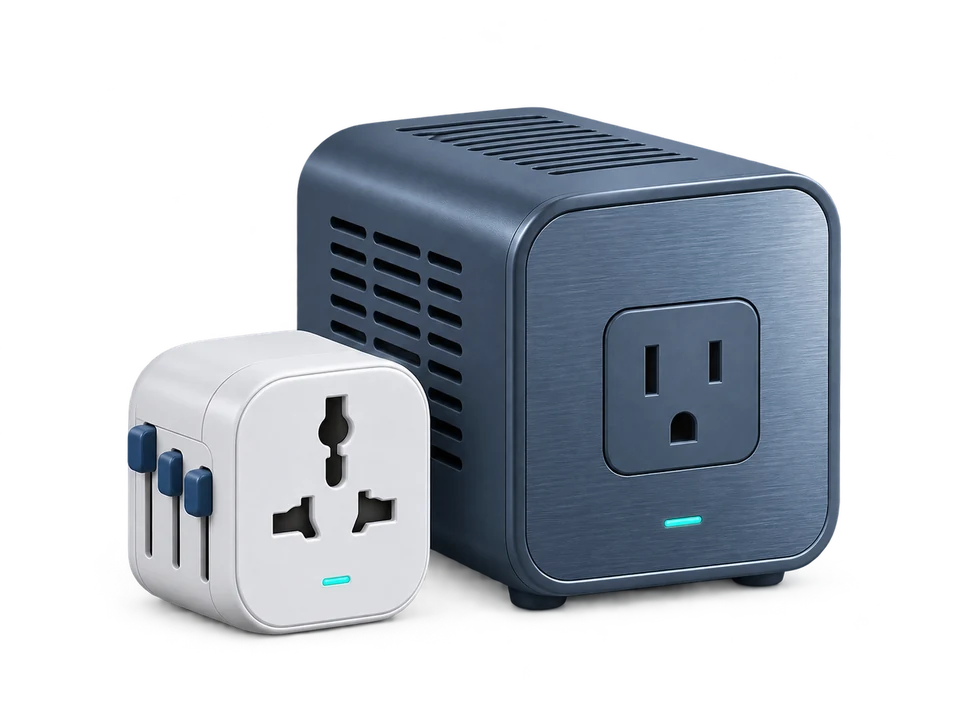
A plug adapter does not convert voltage. Plugging a 120 V device into 230 V through a passive adapter does not reduce anything. The device receives 230 V.
The difference in one table
| Plug adapter | Voltage converter | |
|---|---|---|
| What it changes | The pin arrangement, so your plug fits the wall socket | The voltage delivered to the device |
| What it does not change | Voltage, frequency, available current | Frequency in inexpensive models; waveform quality varies |
| Typical size and cost | Small, inexpensive, no rating usually needed for phone chargers | Bulkier and heavier; wattage rating is critical |
| Needed when | The socket shape differs but the device's input range covers the local voltage | The device is single-voltage and cannot accept the local supply |
| Wrong tool when | The device is single-voltage 120 V and the destination is 230 V | The device already states 100–240 V on its label |
The question that decides it
Read the INPUT line on the device. It is the only thing that settles the matter.
| Label says | Traveling to a 230 V country | Traveling to a 120 V country |
|---|---|---|
100–240 V~ 50/60 Hz | Plug adapter only (if the shape differs) | Plug adapter only (if the shape differs) |
220–240 V~ 50 Hz | Plug adapter only | Not intended for 120 V — a converter is required or the device stays home |
120 V~ 60 Hz | Not intended for 230 V — a converter is required or the device stays home | Plug adapter only |
| No label visible | Find the specification in the manual before deciding; do not guess | Same |
Why "universal travel converter" claims deserve caution
Inexpensive converters frequently advertise support for everything from shavers to hair dryers. In practice those products are usually designed around resistive heating loads with short duty cycles, and their output waveform may not suit devices with motors or electronic power supplies. Two practical rules follow:
- Match the wattage, with margin. A converter rated below the appliance's wattage is a fire and failure risk, not an inconvenience.
- Do not put a converter in front of a USB charger. If a USB charger is marked 100–240 V, it already handles the local supply. Adding a converter introduces a failure point and gains nothing.
High-power appliances are outside this site's recommendation logic
Hair dryers, curling irons, straighteners, kettles and space heaters draw currents an order of magnitude above phone chargers. This site does not give a compatibility answer for them, and no adapters or converters for them are recommended here. If one must travel, check the manufacturer's documentation together with the rating printed on the adapter or converter, and prefer a dual-voltage model sold for travel use. No automatic safety guarantee is offered.
USB ports built into travel adapters
Many travel adapters include USB-A or USB-C ports. That does not make them a laptop charger. Such ports are often limited to a modest output, and the adapter's own rating may be stated for the whole unit rather than per port. Treat a USB port on a travel adapter as suitable for a phone unless the printed specifications say otherwise, and charge a laptop from its own power supply.
Putting it into practice
- Check the destination's socket types and nominal voltage with the travel adapter finder.
- Read the INPUT line of every device you plan to bring, and note whether it is a range or a single voltage.
- For range-rated devices, you need the socket shape only. Frequency differences matter for clocks and motors, not for USB charging.
- For single-voltage devices, decide between a properly rated converter and leaving the device at home. The second option is often the better one.
Related
- Italy travel adapters — a worked country example at 230 V / 50 Hz.
- Travel adapter finder — run the check with your own label values.
- How we calculate — the limits we apply to our own answers.
Reviewed 6 November 2026. This page explains principles; it is not electrical safety certification for any product.